
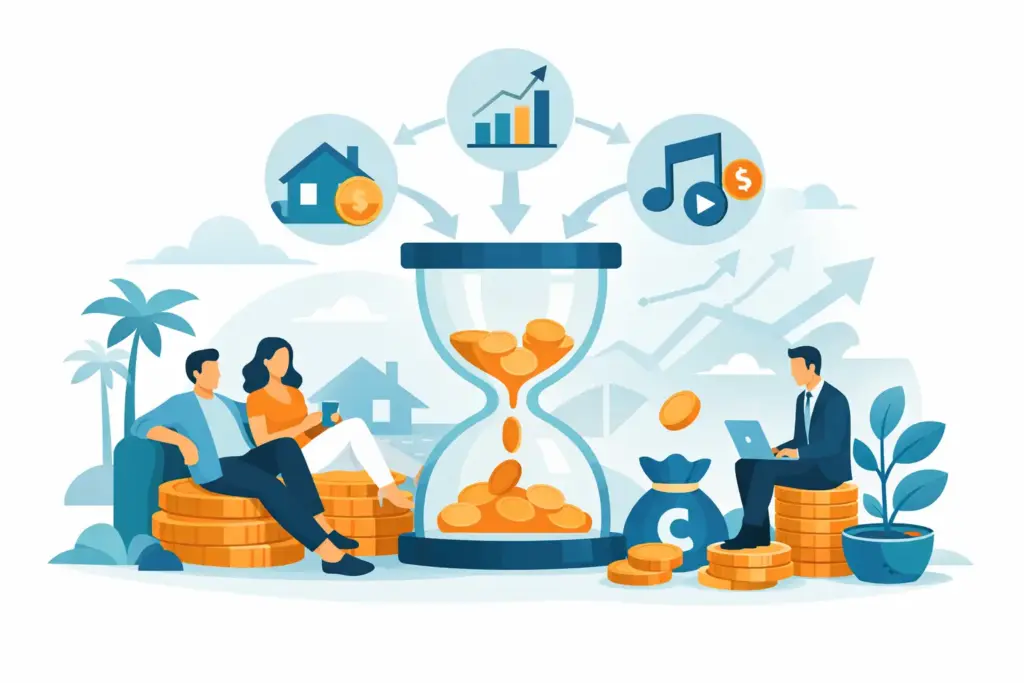
Most people asking what are residual income streams are not looking for a textbook definition. They are looking for a way out of the monthly reset. You work, you get paid, and then next month you start again from zero. That cycle gets old very quickly, especially if you have already tried side hustles that promised freedom but delivered another job in disguise.
Residual income is attractive because it changes the pattern. Instead of being paid once for one burst of effort, you build something that can keep paying you over time. That sounds simple, but this is where many people get misled. Not every so-called passive income idea is truly residual, and not every residual model is worth your time.
What are residual income streams?
Residual income streams are income sources that continue to pay you after the initial work has been done, often on a recurring basis. In plain English, you do the setup work once, or build the asset once, and then it can keep generating income without you having to start from scratch every single month.
That does not mean no work. It means different work. Instead of constantly chasing the next sale, the next client, or the next shift, you focus on building systems, customer retention, subscriptions, referrals, or assets that carry forward.
This is why the idea matters so much to people who are fed up with traditional network marketing, freelance work, or one-off selling. If every pound depends on your latest effort, you have built pressure, not freedom.
The difference between active income and residual income
Active income is straightforward. You work a shift, you invoice a client, you complete a project, and you get paid once. Stop working, and the money stops too. There is nothing wrong with active income, but it has a ceiling. Your time is limited.
Residual income works differently. The goal is to create ongoing payment from past effort. Think of a subscription member who renews each month, a service customer who stays on a plan, or a business structure where repeat volume continues to generate commissions. The real power is not the first payment. It is the repeat payment.
That is why recurring models are so attractive. A one-off sale can feel exciting, but a predictable monthly stream gives you something better – momentum.
Why residual income streams matter more than ever
The cost of living has not exactly been polite. More people in the UK are looking for a second income, but they do not want another exhausting commitment. They want leverage. They want a business they can build from home without pestering mates, storing products in the spare room, or spending every evening chasing reluctant prospects.
This is where residual income becomes more than a buzzword. It becomes a practical business filter. If an opportunity only pays once, you need to keep replacing effort with more effort. If it pays monthly through customer subscriptions, memberships, repeat orders, or ongoing commissions, you are giving yourself a better chance of building something stable.
Of course, stable does not mean guaranteed. Some people hear residual and imagine easy money. That fantasy is one reason so many get disappointed. Residual income rewards smart setup, the right model, and consistency. It is not magic. It is maths.
What residual income streams look like in real life
A good residual income stream usually has one of three foundations. It is based on ownership, subscriptions, or systems.
Ownership means you hold an asset that keeps producing value. That could be rental property, dividend-paying shares, or intellectual property such as a course or book. These can work well, but some require capital, specialist knowledge, or patience that many beginners do not have.
Subscriptions are often more accessible. If people pay monthly for access, benefits, services, or products they continue using, the income can repeat. This is why subscription-led business models have become so appealing. They create continuity instead of constant restarting.
Systems-based residual income sits in the middle. You build a process that keeps producing results with less day-to-day effort. That could include affiliate income from recurring memberships, automated lead generation funnels, or network marketing structures with genuine repeat customer volume. When done properly, the system works even when you are not having a perfect week.
Which models suit beginners best?
If you are starting with limited capital and limited spare time, the best residual income model is usually the one you can actually stick with. That sounds obvious, yet plenty of people chase ideas that look clever on paper but are a poor fit in practice.
Property can produce residual income, but it is hardly low-friction. Dividend investing can build long-term wealth, but unless you already have significant funds, it may not move the needle quickly. Creating digital products can work, but only if you know how to attract an audience and convert buyers.
For many people looking for home-based income, subscription-driven affiliate and network marketing models are worth serious attention. Why? Because they combine low startup costs with recurring commissions. Better still, when the offer is tied to monthly value rather than one-off hype, retention can be stronger.
That said, there is a major catch. Most people do not fail because the compensation plan is bad. They fail because they have no reliable way of finding people. They join, get excited, speak to a few friends, post awkwardly on social media, hear silence, and then assume the whole model is broken.
The truth is harsher than that. A recurring income opportunity without lead flow is like a car without fuel.
What makes a residual income stream strong?
Not all recurring income is equal. A strong residual income stream has simple economics and a reason for people to stay.
First, the product or membership needs real ongoing value. If people are only joining for the dream and not for the benefits, drop-off will be high. Residual income depends on retention, not just recruitment.
Second, the barrier to entry needs to be sensible. If the costs are heavy, the commitment is complicated, or the learning curve is steep, many people will never build enough momentum to reach consistency.
Third, the system has to support duplication. If success depends on charisma, hard selling, or chasing your warm market, it is not a serious model for most ordinary people. A stronger model allows people to plug into a process that is simple, repeatable, and automated where possible.
This is why subscription-based opportunities backed by follow-up systems and pre-enrolment funnels are gaining attention. They remove some of the chaos. Instead of having to become a full-time salesperson overnight, you can focus on directing people into a process that educates and filters for interest.
What are residual income streams not?
They are not instant. They are not effortless. And they are not a free pass around learning basic business skills.
You still need to choose wisely. Some recurring income offers look exciting at the start but collapse under weak retention, poor leadership, or unrealistic expectations. Others pay so little that even with consistency the results stay modest. It depends on the offer, the support, and the system behind it.
This is where people need to be honest with themselves. If you want residual income but hate following a process, hate learning simple marketing, and quit after one quiet week, you are not really building a stream. You are testing a fantasy.
The upside is that you do not need to be perfect. You just need a model that gives your effort a longer shelf life.
Why subscriptions are such a powerful route
Subscriptions solve one of the biggest problems in business: unpredictability. One-off sales are noisy. Some months look great, others look terrible. Recurring subscriptions smooth that out. Even a modest base of paying members can create confidence and cash flow that is much harder to achieve with one-time offers alone.
That is why so many entrepreneurs now prefer membership-style income over constant launch cycles or random affiliate commissions. If the subscription genuinely helps people save money, access benefits, improve health, or solve a repeated need, it has a better chance of lasting.
For the average person who wants to build from home, this matters. You do not need thousands of customers overnight. You need a system that helps you steadily add and retain the right people.
The smarter question to ask
Instead of only asking what are residual income streams, ask this: which residual income stream gives me the best chance of consistency without turning my life into another full-time grind?
That question changes everything. It forces you to look beyond hype and towards structure. Does the model pay monthly? Does it offer real value? Can you market it without harassing people you know? Is there support? Is there automation? Can an ordinary person duplicate it?
If those answers are weak, move on. If they are strong, you may finally have something worth building.
A lot of people have been burnt by old-school methods that relied on pressure, home meetings, and exhausting follow-up. There is a better way now. The strongest residual models are not built on chasing. They are built on positioning, systems, and recurring value. That is one reason brands such as Vitality Maestros are speaking so directly to people who want subscription-led income without the usual network marketing headaches.
If you are serious about building extra income, stop looking for the perfect fantasy and start looking for the right model. Residual income is not about doing nothing. It is about doing something once, well enough, that it keeps paying you long after the first effort is made.