
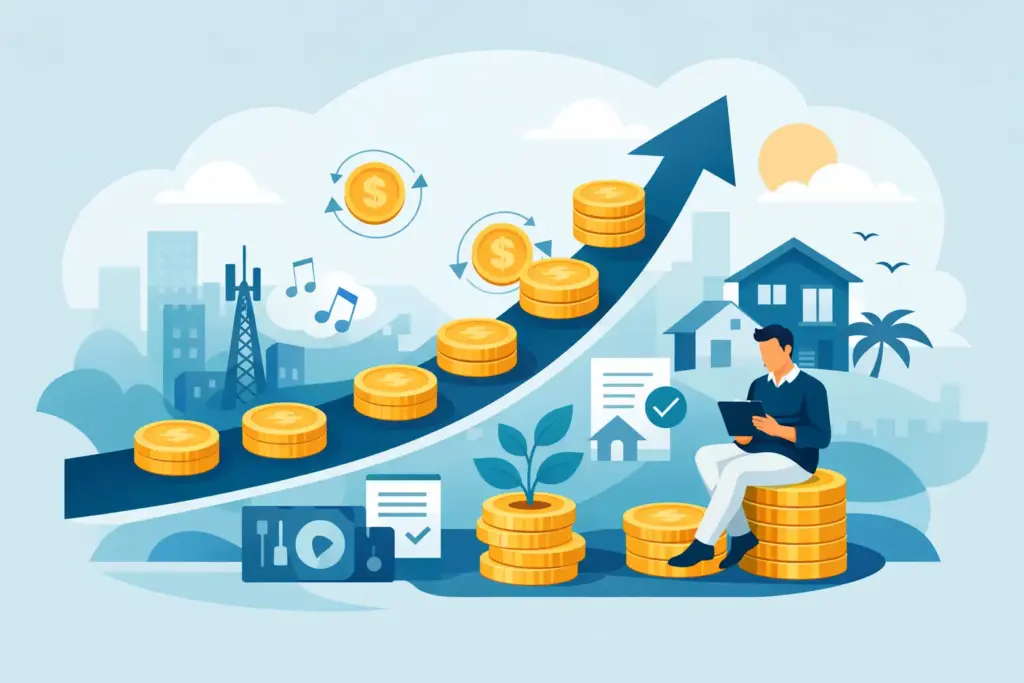
Most people are not actually chasing money. They are chasing relief. Relief from bills that keep coming, jobs that keep taking, and business models that force you to start from zero every single month. That is why the question what is residual income model matters so much. It is not just a finance term. For a lot of people, it is the difference between constantly hustling for the next sale and building something that can pay you again and again.
If you have ever tried old-school network marketing, affiliate offers, freelancing, or one-off online sales, you already know the problem. You can work hard, make a bit of money, then wake up the following month almost back at the beginning. That is exhausting. A residual income model aims to change that by creating ongoing earnings from work you have already done.
What is residual income model and why do people want it?
A residual income model is a way of earning where one initial action, customer, referral, investment, or system can continue producing income over time. Instead of being paid once and then needing to replace that income immediately, you create a base that keeps generating revenue.
The easiest way to understand it is to compare it with earned income. If you are paid hourly, your money stops when your hours stop. If you sell a one-off product, that sale is finished once the transaction is complete. But if you build a residual model, the same customer relationship can keep producing value month after month.
This is why subscriptions get so much attention. Memberships, software plans, service retainers, insurance renewals, royalties, rental income, and certain network marketing compensation plans all sit closer to residual income than one-time sales. They are built around continuity.
People want this because recurring income creates breathing room. It can smooth out the feast-or-famine cycle. It can make growth more predictable. And it can reward smart setup rather than endless chasing.
That said, residual income is not magic. It is not money for nothing. Most models still need customer retention, support, systems, and consistent attention. The difference is that the effort can compound instead of resetting.
How the residual income model actually works
At the centre of the model is one simple idea – recurring value leads to recurring payment. If somebody keeps receiving a benefit, they are more likely to keep paying. If a company keeps benefiting from your referral or work, it may keep paying you too.
Let’s say you introduce ten customers to a subscription service. If each one stays active and the compensation plan pays monthly commissions, your income does not only depend on finding ten new people every month. You now have a small income base. If that base grows and retention stays strong, your monthly earnings can increase without your workload rising at the same speed.
This is where many people either get excited or get it wrong. The excitement comes from leverage. The misunderstanding comes from thinking leverage means no effort. It does not. A residual income model works best when three things are true: the product or service is genuinely useful, people keep using it, and the system for acquiring customers is not painfully manual.
If one of those pieces is weak, the model becomes unstable. If customers quit quickly, your residual income leaks. If the offer is overpriced, renewals suffer. If you have to chase every lead by hand, the business can still feel like a grind.
The biggest advantage – you stop rebuilding from scratch
This is the real attraction. Not hype. Not fantasy. Just economics.
In a one-off sales model, every month can feel like a reset. You need fresh buyers, fresh conversations, fresh effort. That can work, but it is tiring and often unpredictable. In a residual income model, each customer or member can add to a growing foundation.
That foundation matters because it changes your relationship with time. Instead of only being paid for what you do today, you can also be paid for what you built yesterday. Over time, that creates momentum.
For people looking at home-based business models, this is especially appealing. You do not necessarily want a second job in disguise. You want something that can build. Something that can continue working even when you are not glued to your mobile, messaging people you vaguely remember from school.
That is also why subscription-led opportunities often stand out more than traditional product-pushing models. If customers see regular value and stay subscribed, the compensation structure can become far more attractive than constantly chasing one-time purchases.
Where people get burned by residual income promises
Now for the truth that too many marketers skip.
Not every business calling itself residual income is worth your time. Some use the phrase to sell the dream while hiding the reality. If the offer depends on endless recruitment but has weak customer value, the income can collapse quickly. If the pricing is poor, people leave. If the system relies on pestering friends and family, most people burn out before they build anything meaningful.
This is why the model matters, but so does the vehicle.
A good residual income model has staying power. It is built around something people want to keep paying for. It is simple enough for ordinary people to share. It does not require expert-level selling. And ideally, it has systems in place to help with lead generation, follow-up, and conversion.
That last point is a big one. Plenty of people have failed in network marketing not because they were lazy, but because the method was outdated. The old script was always the same – make a list, ring everyone you know, chase people, collect rejection, repeat. That is not freedom. That is friction.
What is residual income model in a modern home business?
In a modern home business, the residual income model usually combines recurring subscriptions with automated marketing. That means instead of relying entirely on manual outreach, the business uses funnels, educational content, email follow-up, and systems that help prospects see the offer before they ever speak to you.
That changes everything.
When a model is supported by automation, your job shifts from chasing to directing traffic and letting the system do more of the heavy lifting. You still need to learn. You still need to take action. But you are no longer trapped in the old pattern of convincing reluctant people one by one.
For the right person, this makes residual income far more realistic. You are not just buying into an idea. You are plugging into a process.
That is one reason subscription-based opportunities have become more attractive to people who are serious about building from home. When recurring commissions are paired with better lead flow and simpler presentations, the business can start to behave more like a system and less like a struggle.
Who the residual income model suits best
It suits people who think beyond this week’s cash. If you need instant money tomorrow, residual income is rarely the fastest fix. It takes setup, consistency, and some patience. But if you want to build a base that can grow over time, it becomes far more compelling.
It also suits people who are tired of starting over. If you have had enough of one-off wins followed by dry spells, you will probably see the appeal immediately. The same goes for anyone who likes the idea of leverage, automation, and repeatable systems rather than constant face-to-face selling.
What it does not suit is someone looking for zero responsibility. Even the best residual income model needs monitoring. Customers need value. Follow-up still matters. Retention matters even more. Passive is often overstated. Predictable is usually the better word.
How to judge whether a residual income model is worth pursuing
Ask a few blunt questions.
Would people still pay for this if there were no compensation plan attached? Do customers stay because the product or service helps them? Is the monthly cost low enough to feel easy but valuable enough to justify renewal? Can an average person explain it without sounding pushy? Is there a genuine system for lead generation, or are you expected to nag your contacts until they hide from you?
If the answers are strong, the model may have legs. If the answers are shaky, the residual income promise may be doing more work than the business itself.
This is where smart positioning matters. A simpler offer with recurring value often beats a complicated one with flashy claims. People stay where they feel the benefit. They leave where they feel pressure.
And yes, support matters too. The right mentorship can compress the learning curve massively. That is one reason some people look at systems such as Vitality Maestros – not just for the opportunity itself, but for a cleaner path into recurring-income business building without the usual prospecting headache.
The real point of residual income
The real point is not to sit on a beach and do nothing. It is to stop living in permanent reset mode.
A residual income model gives you a chance to build income that has memory. Income that does not vanish the moment you stop for a day. Income that grows because the right customers keep receiving value and the right systems keep working in the background.
That is why this subject gets attention from entrepreneurs, side-hustlers, and people desperate to escape the trap of trading time for money. They are not looking for hype. They are looking for a model that can finally make effort stack instead of disappear.
If that sounds like what you have been missing, pay close attention to the vehicle you choose. The right model can change your income. The wrong one just gives you another month of frustration dressed up as opportunity. Choose the path that lets your work keep paying you after the first yes.